Case study
ElyzeLabs
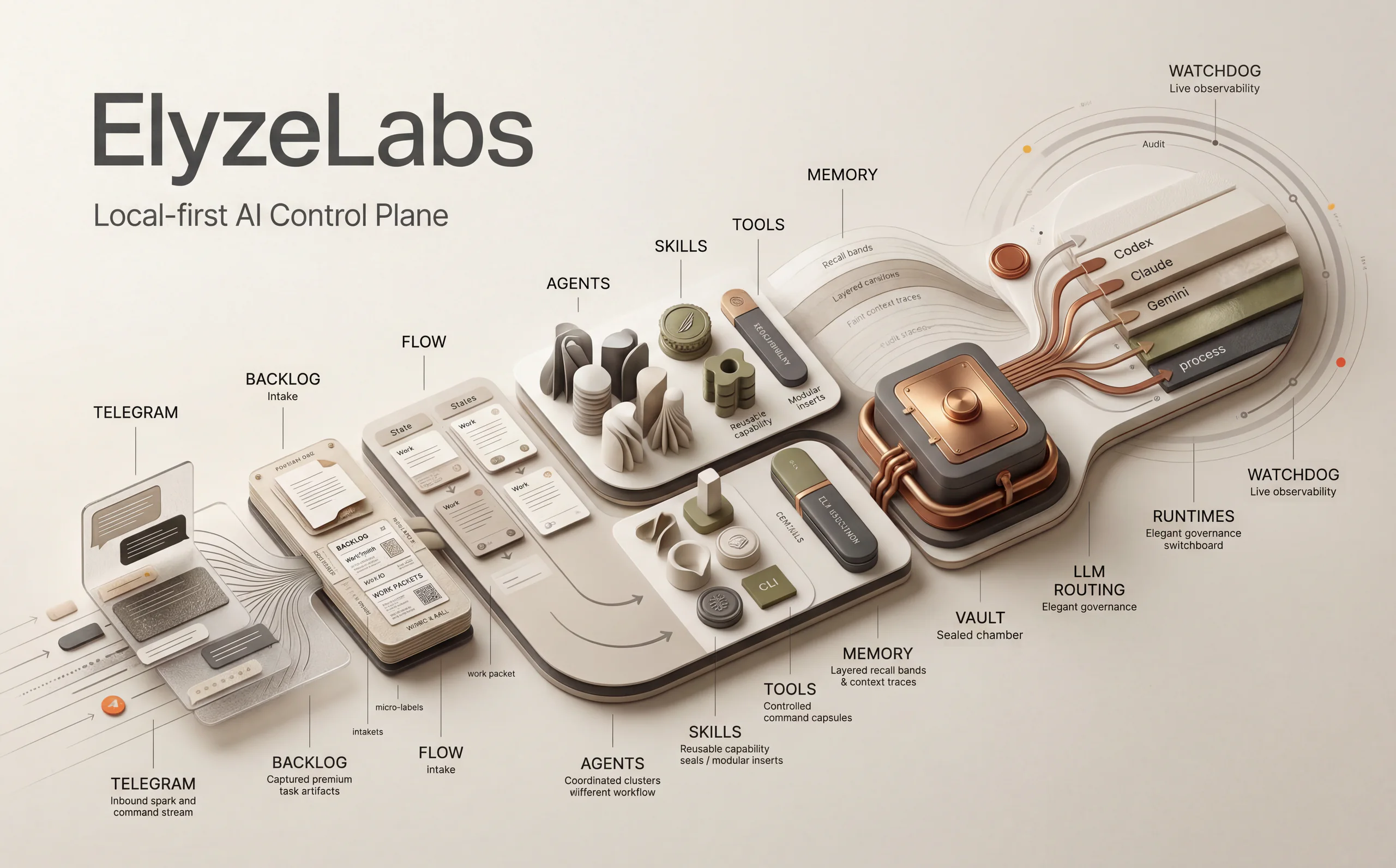
ElyzeLabs is a local-first AI control plane built to run coordinated AI work like an operating system, not a single chat window. It combines Telegram ingress, a typed gateway, queueing, memory, skills, agent delegation, GitHub-backed backlog operations, and encrypted secret handling into one operator-facing environment.
What makes it different
- It treats AI work as structured operations: sessions, runs, queue lanes, retries, watchdog recovery, delivery evidence, and auditability.
- It models agents like a company instead of a flat tool list, with a seeded CEO baseline, agent profiles, subagent delegation, mission control views, and even a virtual office mode.
- It connects planning to execution through backlog orchestration and GitHub integration rather than leaving tasks as loose chat output.
Backlog and GitHub delivery
One of the core ideas in ElyzeLabs is that planning should stay connected to real delivery work.
- Backlog items, transitions, dependencies, delivery groups, and orchestration decisions are first-class data structures in the control plane.
- GitHub repository connections, issue sync, webhook replay, and delivery links let backlog items stay tied to actual repos, issues, pull requests, and repository evidence.
- The system is designed to avoid fake completion by requiring delivery evidence before certain review flows and by keeping backlog state, repo linkage, and operator review in sync.
This is the part the first summary missed most clearly: ElyzeLabs is not only routing AI prompts, it is managing work across planning, delegation, GitHub coordination, and delivery tracking.
Agents acting like a company
ElyzeLabs also has a strong organizational model.
- A CEO baseline and company identity can be seeded during onboarding.
- Agent profiles and subagents carry role prompts, runtime defaults, and delegation rules.
- The dashboard exposes that structure through office and org-chart style views so the system feels like a controllable team, not an opaque swarm.
That “agents acting as a company” layer is not decorative. It is how the platform frames ownership, delegation, authorization boundaries, and operator oversight.
Operator surface
The React dashboard is built around operations, not demo-chat aesthetics.
It includes backlog boards, chats, sessions, timelines, cost controls, skills, vault management, mission control, and real-time visibility into how work is moving through the system.
Stack
TypeScript, React, Fastify, SQLite, Docker, pnpm workspaces, SSE, GitHub integrations, and structured observability.